 GAMESLASH
Fight World Model lets AI combat follow damage rules instead of just looking convincing
By GameSlash
New research from October 29 tests an AI combat world model that keeps hits, health and lifesteal tied to executable game rules. Here's what game creators can learn.
A research team published Fight World Model (FWM) on October 29, 2026, tackling a specific problem with AI-generated fighting games: a video may show a successful attack while the health bar, damage and follow-up reactions disagree with the actual rules. FWM puts an executable combat system in charge of those outcomes and asks a video model to visualize them.
This is a research prototype for two-fighter combat, not a released Unity or Godot plugin and not a prompt-to-playable-game service. Its value to game creators is the separation between what the game decides and what AI draws.
How the new system works
Rather than asking a video model to invent the entire fight, the rule engine calculates character positions, attacks, hit events and health changes. A deterministic converter turns these events into visual cues aligned with the video timeline. The generator then renders the fight using those cues and character or arena references.
The proxy distinguishes an attempted move from a hit reaction and a lasting change in health. That matters when a fighter blocks damage, receives a hit without losing HP, or steals health from an opponent. It also helps keep the correct character linked to an action when fighters swap sides.
What the research measured
The researchers constructed 112,618 training samples from gameplay recordings and edited variations, covering 52 visual skill effects, 187 fighter appearance variants and 15 arenas. In their controlled interaction-fidelity comparison, FWM reported a 98.48% joint score versus 76.35% for the spatial-proxy-plus-text variant, and a health-state mean absolute error of 0.15 percentage points.
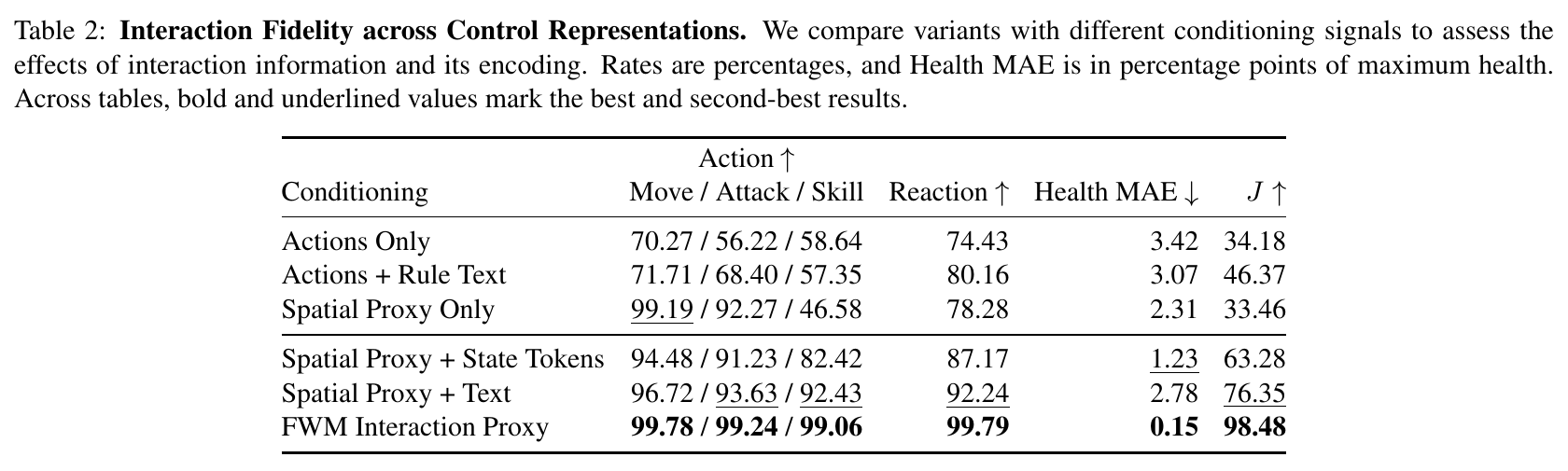
Those figures are the authors' results on their chosen two-fighter dataset and testing protocol. They do not prove that an ordinary game developer can drop the model into a shipping game or that it generalizes to other genres.
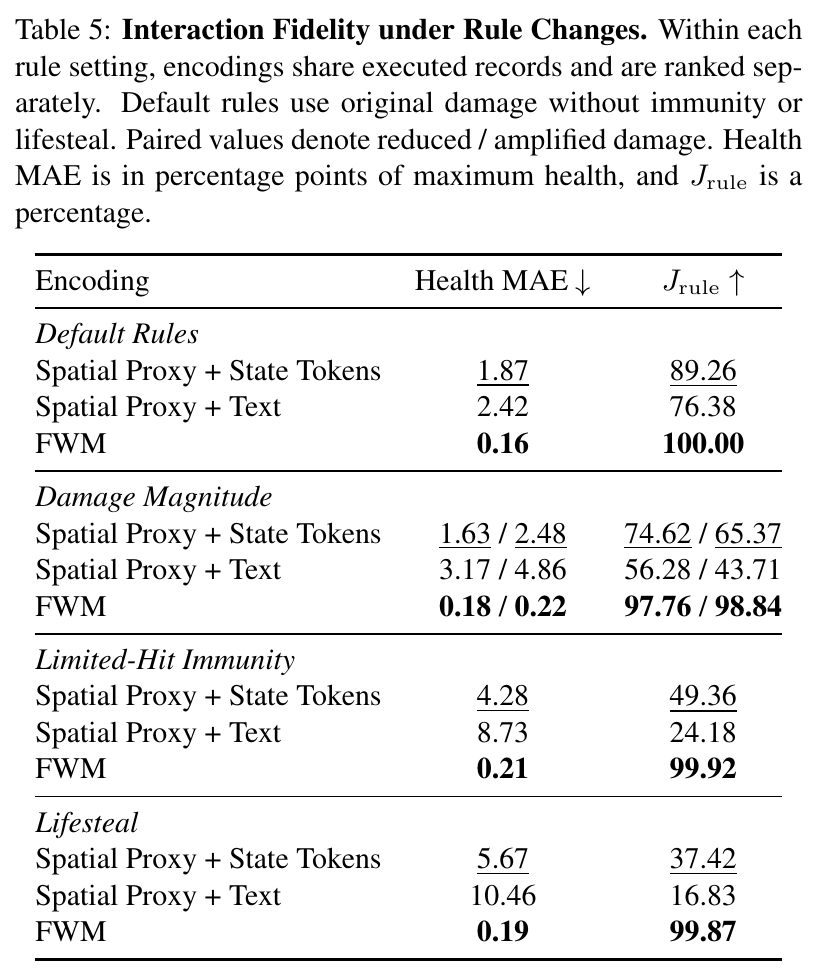
A separate experiment changes the rules without retraining the renderer. Under limited-hit immunity, the authors report a health error of 0.21 percentage points and a 99.92% rule-interaction score; under lifesteal, the corresponding values are 0.19 and 99.87%. This tests a different question from visual quality: whether generated reactions and lasting health changes follow the revised rules. These are controlled research results, not a production reliability guarantee.
Why this matters for AI game creators
The practical lesson is straightforward: make damage, cooldowns and win conditions executable and testable, then let generated visuals follow confirmed game events. Even creators working in conventional engines can apply this design principle without using the paper's model.
Read the original paper for the complete methods, tables and figures. The preprint was submitted on October 29, 2026. The two tables reproduced here are the authors' reported research results, not an independent GameSlash test.