 GAMESLASH
NPCs can chat, but can they make plans? The Unnamed Town shows how
By GameSlash
Explore an open-source AI text adventure where NPCs remember deals, form plans and act on their own. See the real screenshots, setup and practical limits.
Many game NPCs can answer a player's questions, then stand idle until the next dialogue. What would change if a tavern keeper could remember a deal, form a plan with another character, and act on it while the player was away? The Unnamed Town is an open-source text adventure that experiments with exactly this problem.
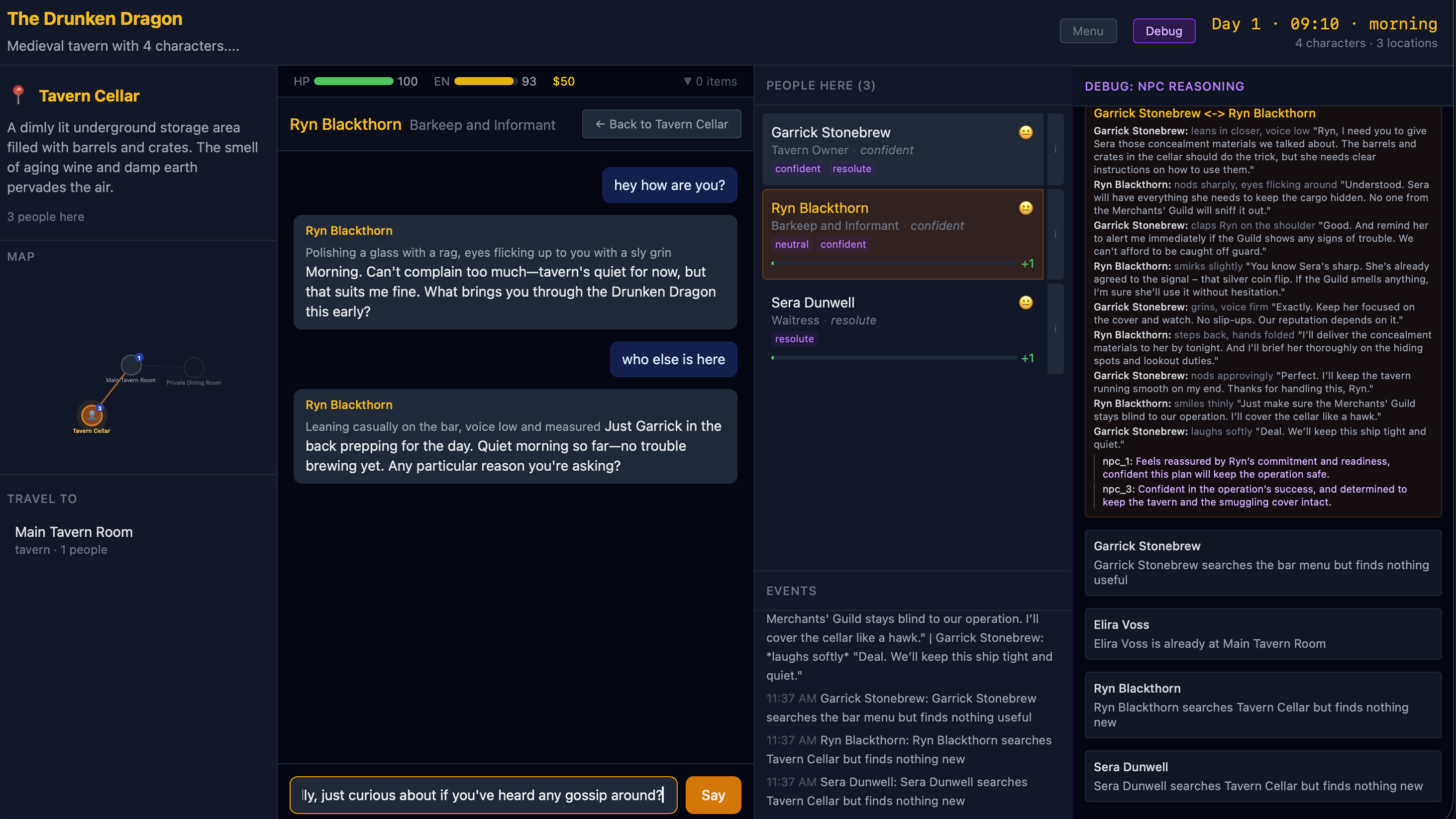
Its creator's GitHub documentation describes autonomous non-player characters with goals, memories, relationships, social conversations and multi-step plans. It is an actual TypeScript/React project with runnable source and screenshots. These are developer-reported capabilities, not our own gameplay test.
How do these NPCs do more than chat?
An NPC does not simply read a static dialogue list. It selects goals, plans a few actions, navigates to other townspeople, negotiates or changes an agreement, then replans when circumstances change. The world keeps progressing through simulation ticks. Player actions are judged by an AI 'game master' that can update inventories, injuries and other in-game state.
The crucial design trick is separating what the language model suggests from the game's actual state changes. The state engine manages items, character conditions and agreements; the AI proposes conversations and actions based on memory and current circumstances. That gives a game builder a more useful blueprint than just plugging a chatbot into an NPC.
Memory is selective rather than unlimited: the documented system retrieves up to 30 relevant memories per prompt and consolidates older entries into summaries.
Look at a real NPC plan, not just a concept
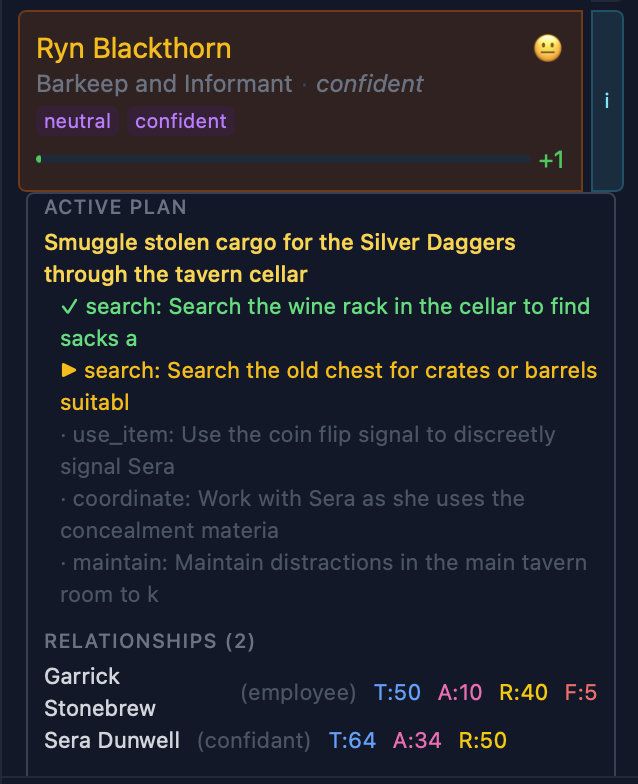
The repository includes a screenshot of Ryn Blackthorn's plan around a smuggling operation. It marks finished steps, the current step and future steps. This is one example the developer captured, not evidence that every AI plan succeeds or that characters never contradict one another.
Can a beginner actually try it?
The author offers a Docker-based setup: copy `.env.example` to `.env`, add an OpenAI API key, then run `docker compose -f docker-compose.dev.yml up`. The local interface is documented at `http://localhost:5173`. A non-Docker install also requires Node.js and PostgreSQL. This is a code project to run on your computer, not a no-sign-up instant-play website.
The developer lists model calls for player chats, conversations, planning and world generation, so API usage can cost money. It also provides a debug view showing why characters decided to act. To study a similar system for your game, start with just one character who remembers a promise and carries out one small multi-step task.
What should creators take away?
For vibe coding, the useful pattern is a loop: a character receives goals, retrieves relevant memories, proposes an action, the game checks and records its outcome, then the character reacts to the updated world. Without the check-and-record stage, 'smart' NPCs may merely tell convincing stories without actually affecting gameplay.
Read the source code and setup instructions and the MIT license. This article is an educational project analysis based on developer documentation reviewed in October 2026, not a claim of a newly launched October 27 product or an independent hands-on review.