 GAMESLASH
AEON turns video-generation latents into 4D worlds with controllable views
By GameSlash
Tsinghua researchers introduce AEON, a research model turning video-generation latents into editable 4D Gaussian worlds with controllable time and camera angles.
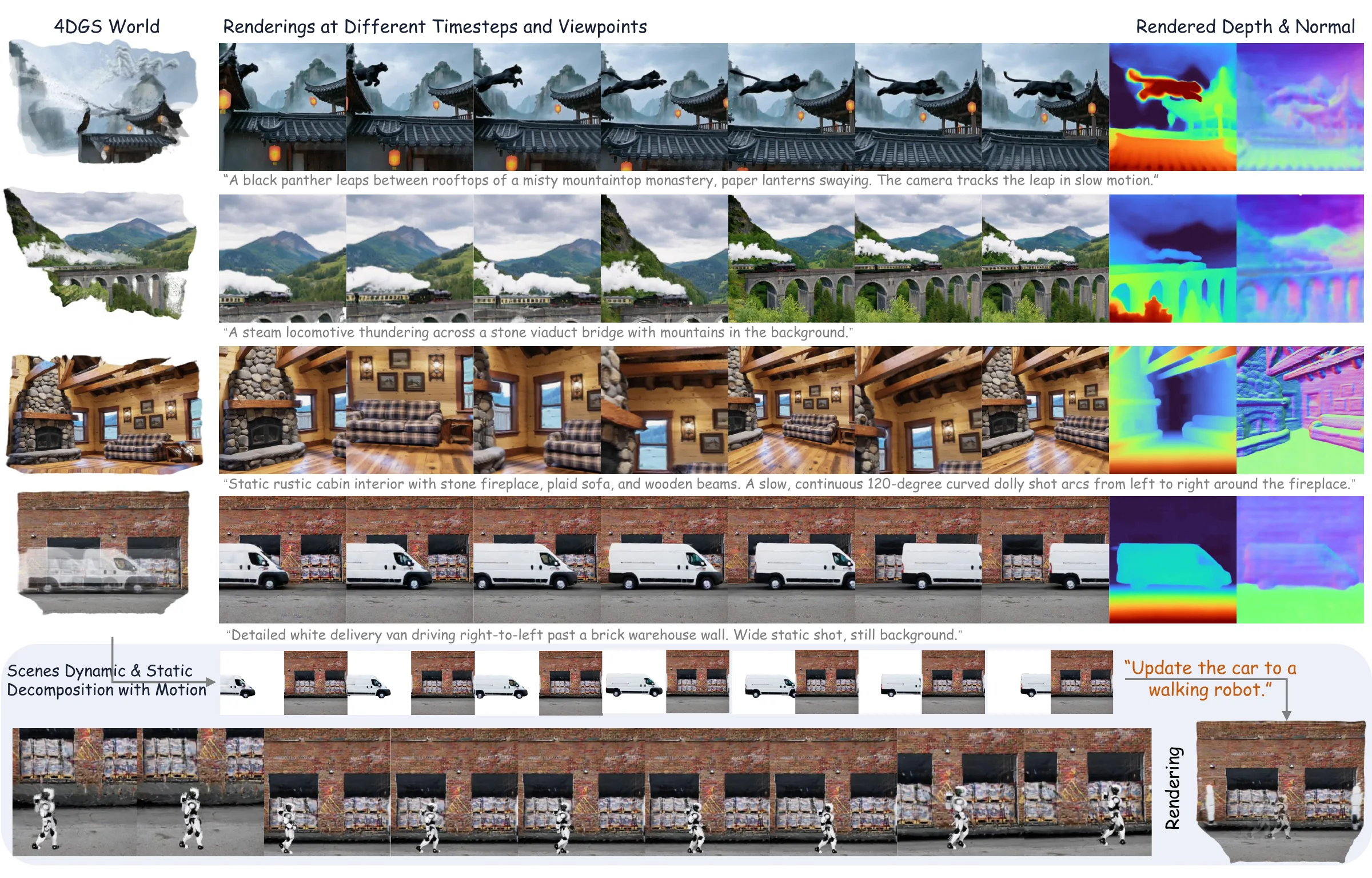
Researchers at Tsinghua University posted AEON: Unifying Video and 3D World Models on October 20, 2026. The NeurIPS 2026 paper proposes converting a video-generation model's latent representation into an explicit, time-aware 3D scene rather than treating the generated clip as the only output.
What AEON changes
Conventional video generators can produce compelling motion but a sequence of frames is difficult to navigate consistently from arbitrary camera positions. An explicit 3D scene offers controllable camera movement, yet static geometry alone cannot describe moving elements. AEON combines these approaches by decoding video latents into 4D Gaussian Splatting (4DGS): scene primitives with positions, visual attributes and temporal motion.
The researchers describe real-time rendering of the same world from different viewpoints and timestamps. The official interactive project gallery presents 62 examples created from text or an input image; each can be rendered as RGB, depth and surface normals. These are demonstrations presented by the research team, not independent gameplay tests.
The actual model pipeline
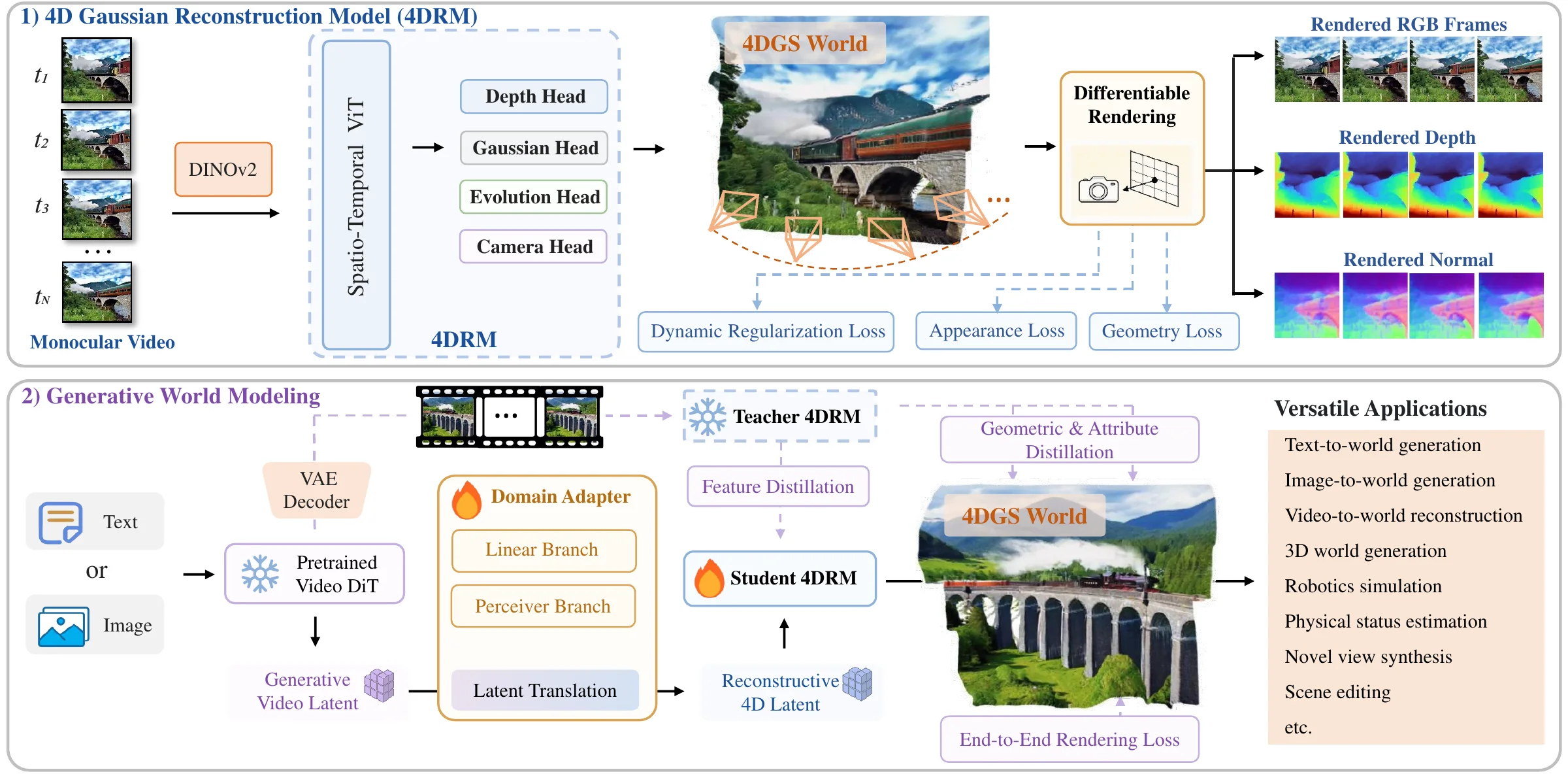
AEON first trains a 4D Gaussian Reconstruction Model (4DRM) to infer cameras and 4D Gaussians from monocular video. A domain adapter then transfers features from a frozen video diffusion model into a student reconstruction network. A final rendering-refinement stage optimizes the output against decoded video frames. The paper discusses motion-aware attributes such as reference time, duration and velocity.
Why game developers should care — and what is not proven
A scene that supports new camera views, time control and editable dynamic primitives could inform future game-world prototyping, virtual production or simulation research. However, AEON is a research implementation: the release does not demonstrate a complete playable game, AI-controlled character logic or ready-made Unity, Unreal or Godot integration.
The project demonstrates research outputs rather than a ready-made production workflow. Practical integration, interactivity and performance in shipped games still require independent testing.
Sources: research paper (submitted October 20, 2026); official project demonstrations.