Back to Tools
Online systems and backends

Gaffer On Games: Snapshot Interpolation

By Glenn Fiedler

Understand snapshot interpolation and its bandwidth-versus-display-delay tradeoff.
guide
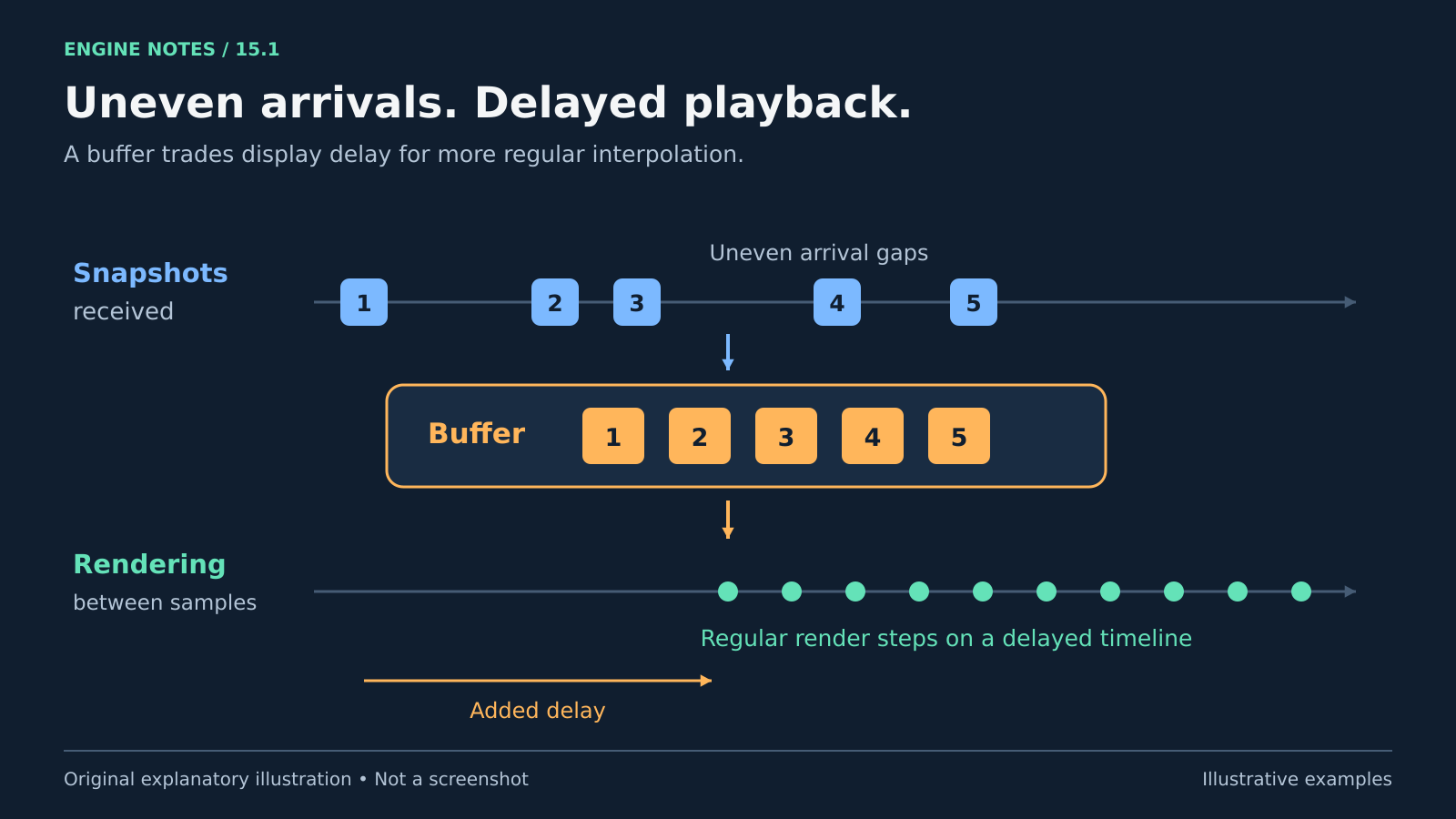
Irregularly spaced snapshots feed a buffer. Regular render steps then sample a delayed timeline between snapshots, illustrating smoother playback at the cost of delay.
Conceptual timing, not a suggested buffer duration. Actual buffering depends on send rate, jitter and packet loss. Original explanatory artwork prepared for GameSlash with AI assistance. Documentation is credited as the factual source only; no source imagery reused. Concept source

Use it for: Understanding remote-object motion in multiplayer games.

Start: 1) Send position/orientation and snapshot sequence numbers. 2) Keep an interpolation buffer. 3) Render between delayed snapshots instead of immediately showing the newest one.
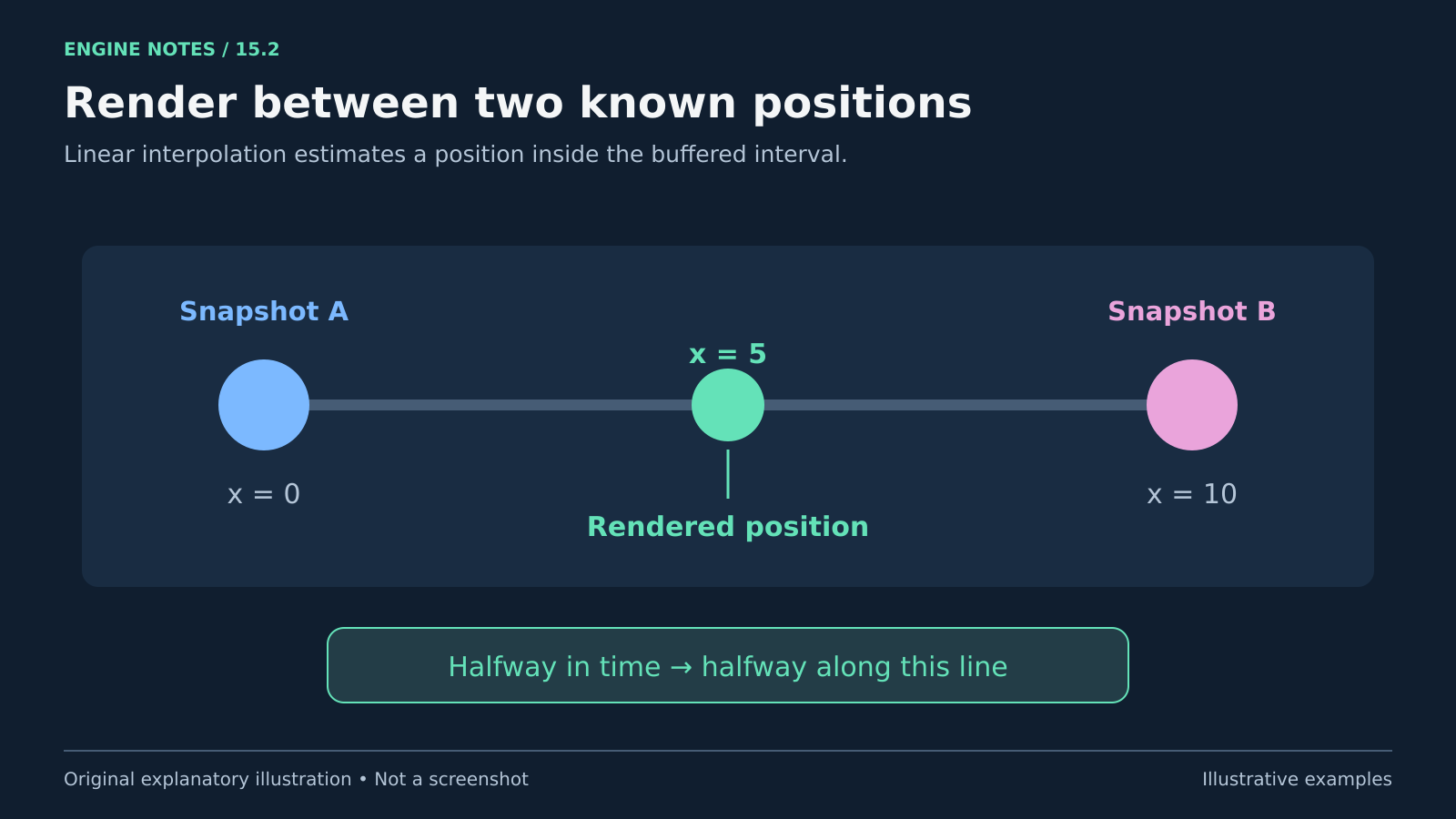
Two buffered position samples at x equals zero and x equals ten are connected by a line. At halfway through their time interval, linear interpolation renders x equals five.
Synthetic one-dimensional interpolation example. It illustrates position only, not prediction, authority or anti-cheat. Original explanatory artwork prepared for GameSlash with AI assistance. Documentation is credited as the factual source only; no source imagery reused. Concept source

Try checking: Compare jitter/loss behavior while measuring both smoothness and display delay. Do not copy the example’s buffer delay as a universal setting.

Limits: Buffering adds latency and snapshots consume bandwidth. This is a model, not a complete prediction, authority or anti-cheat system.

Source: Author’s guide

View source