 GAMESLASH
NPCs keep following fixed scripts? GdPlanningAI helps them choose their next action
By GameSlash
A Godot plug-in updated on its store listing October 23 helps game characters choose goals like eating, exploring or resting. See how it works and its limits.
Have you ever built a game character that has to decide whether to eat, explore or rest? Writing a fixed if/else script for every possible situation becomes complicated as the game grows. GdPlanningAI, a Godot add-on, lets developers give characters goals and possible actions so the characters can choose a sequence at runtime.
The developer's Godot Asset Store listing is marked 'Last Updated: October 23, 2026'. Its version note mentions agent configurations and grouping goals and actions into reusable behaviors. The listing's older changelog still names v0.2.0 from December 2025, so the October 23 date should be read as a listing update, not proof of a brand-new product launch. Check the official listing.
For example: how does a hungry character find dinner?
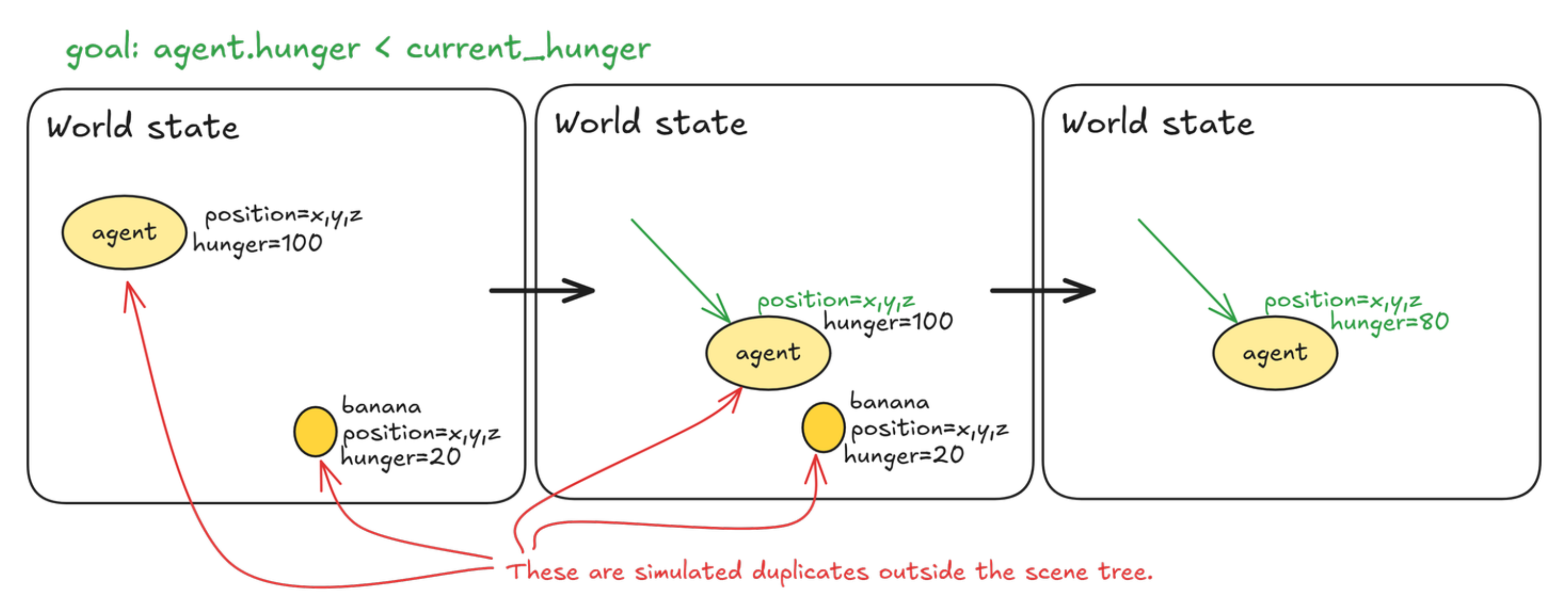
Imagine an NPC (a non-player character) with a 'reduce hunger' goal. Food is somewhere in the level. Instead of manually defining one route for every possible state, the system can look for a chain such as walk to food → pick it up → eat. When the character is no longer hungry, exploring or resting can become the better goal.
Developers still define the available actions, how the world works, and the conditions under which an action can run. This is goal-based planning software, not a chatbot or an LLM spontaneously inventing game mechanics.
What changed, and who benefits?
The October 23 listing's version note highlights agent configuration and reusable groups of goals, actions and properties. Reusing those groups can make it easier to define multiple NPC types—for example a worker, a villager and a guard—without building every decision from scratch.
The project includes sample 2D and 3D scenes and documentation in its source repository. It is Apache-2.0 licensed and the listing requires Godot 4.5.1 or newer. This is a developer plug-in with a learning curve, not a prompt-to-game service for people who have never used Godot. The store also labels the downloadable version unstable.
If you use AI to write your game code, this approach may still help you organize NPC logic: ask your coding assistant to explain the available example scenes, then test one simple character before adding a busy simulation. We reviewed the official documentation and store listing, not a playable test performed by GameSlash.
Sources: Godot Asset Store entry, official repository and Apache-2.0 license.