 GAMESLASH
earshot 1.0 lets Claude Code create 922 kinds of game sound effects locally
By GameSlash
Leon Lin releases earshot 1.0 with a text-to-sound CLI for coding agents: 922 designs, offline CPU rendering and commercial-use terms. Includes real commands and limits.
Leon Lin released earshot 1.0.0 on November 20, 2026. The new 'earshot make' command lets an AI coding agent request a sound effect in plain words and get a fresh WAV or OGG file from a library of 922 sound designs. It is particularly relevant to games built with Claude Code and other agents: the same workflow can produce pickups, footfalls, hits, UI cues and ambiences without sending a prompt to an audio-generation model on every call.
How to make a footstep for a game
Install the skill with npx skills add Leonxlnx/earshot and the Python tool with pip install "earshot @ git+https://github.com/Leonxlnx/earshot". The creator's example earshot make "three variations of a footstep on gravel" -o step.ogg returns three separate sound files and reports duration, peak timing and loudness for each. Python 3.10+ and a CPU are sufficient for basic sound generation. OGG and MP3 output require ffmpeg; WAV does not.
Unlike an online text-to-audio service, the core 'make' command picks from 922 synthesizer designs in 384 families and renders a new variation in local code, with no sound-generation model to download. The developer says 309 designs were learned from 692 public-domain recordings; the repository does not redistribute those audio clips. Browse the official interactive gallery of all 922 sounds to hear what the library can and cannot make.
If the library cannot match the description
The new earshot build command constructs some missing effects from named component sounds and scores the result with an optional listening model. It is stronger for repeated textured effects such as applause, crackling or swarms than voices or clean single musical tones. The base install is lightweight, but listening/model-based criticism requires the listen extra and model downloads. Earshot generates effects, not speech; its music capabilities are limited and should not be represented as a full soundtrack generator.
How agents inspect the timing of an effect
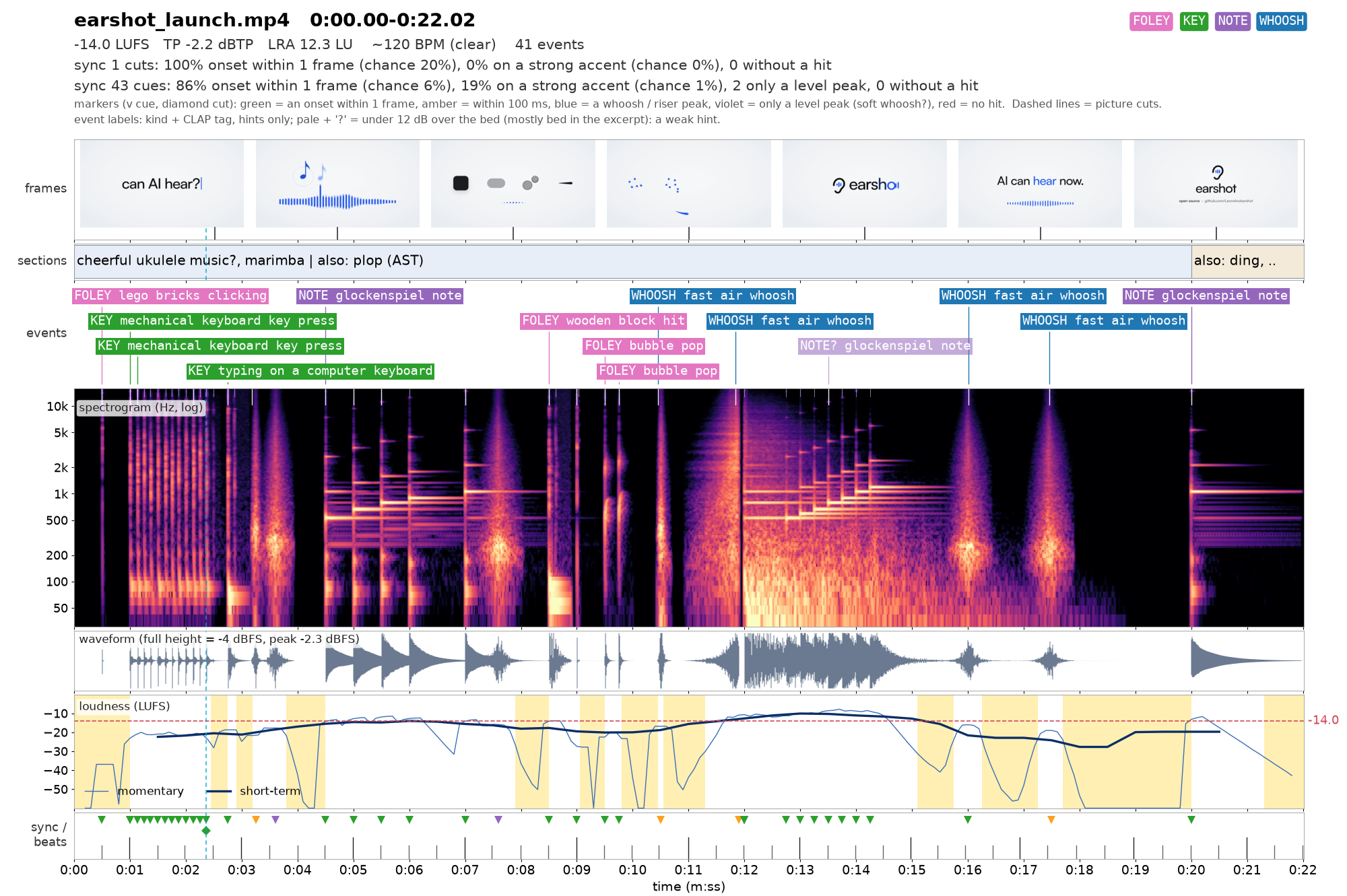
The project also provides a listening, soundtrack-timeline and cue-measurement toolkit inherited from earlier versions. It can report the relation of sound onsets to video cuts and flag technical issues, enabling developers to check timing after laying sounds into game footage. This is a separate analysis feature, not a demonstration of the new v1 generator.
Licensing and limitations
The author states that files rendered by earshot can be used commercially without attribution, and the code uses the MIT licence. That does not automatically cover any other third-party files or music added to a game's final mix. The release notes list Windows and Linux tests but not macOS, and show some limitations on synthesized effects. For version-accurate commands and warnings, see the November 20 v1.0.0 release. GameSlash has not independently listened to or benchmarked the rendered samples.