 GAMESLASH
Ludo shares a free Godot project for fixing AI-rotoscoped pixel-art jumps
By GameSlash
Harbour Jump uses a 49-frame sprite sheet and shows how to restore timing, travel and planted feet from video reference.
On November 25, 2026, Ludo.ai published a technical demonstration of Harbour Jump, a free Godot 4.7 sample first listed on itch.io on November 23 UTC and updated November 25. It turns a 3.9-second reference video into 49 knight sprite frames with Transfer Motion and shows why a good-looking sprite still needs timing and movement corrections.
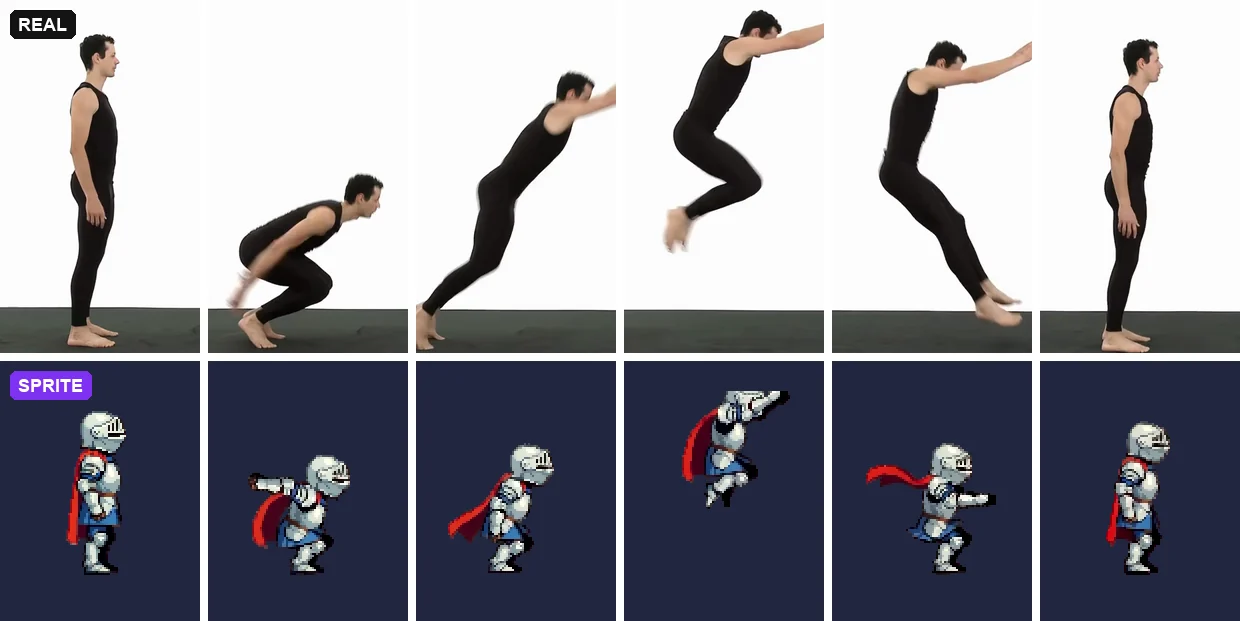
Correct timing and travel separately
Ludo reports that the generated sheet plays in 2.67 seconds instead of the reference's 3.9 seconds. Its airborne phase is about 1.03 seconds versus 0.36 seconds in the reference. The sample assigns durations to individual Godot SpriteFrames using key timestamps, retaining the artwork but aligning takeoff and landing with the filmed motion. The developer used Hydra with a four-second duration, a non-looping output and a 7 by 7 sheet.
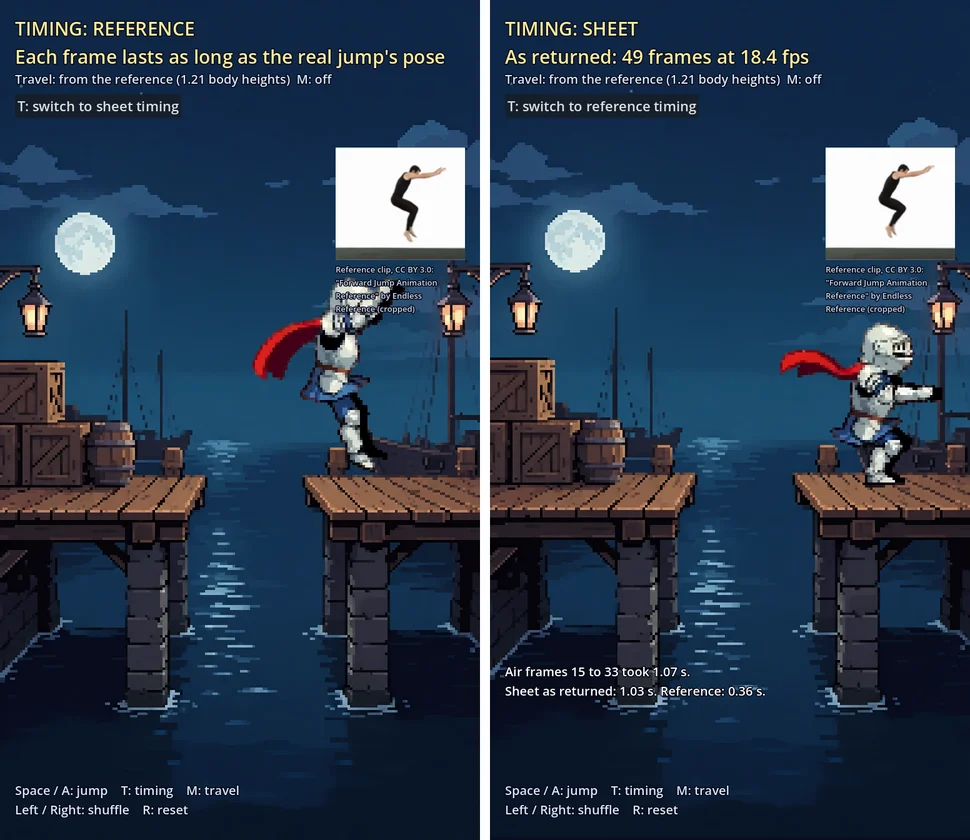
For horizontal motion, the sample measures the filmed distance after correcting camera pan and scales it to the knight's height: about 1.21 body heights, or 396 pixels at the sheet's scale. For planted feet it measures the boot's position frame by frame and compensates drawing offsets. The authors report that their headless test found no planted-boot drift after correction.
The downloadable Harbour Jump project includes the scripts, measurement data, images and a smoke test. Open it in Godot 4.7 or later; T switches timing, M toggles travel and Space jumps. Code is MIT, art is CC BY 4.0, and the adapted motion retains its CC BY 3.0 attribution. See the full technical demonstration.