 GAMESLASH
Ludo Adds Swappable Weapons and Gear to 8-Direction AI Sprite Workflow
By GameSlash
Ludo.ai's November 5 update lets game creators fit separate swords, shields and helmets to rigged 3D characters before generating eight-direction 2D sprite animations, including through API and MCP.
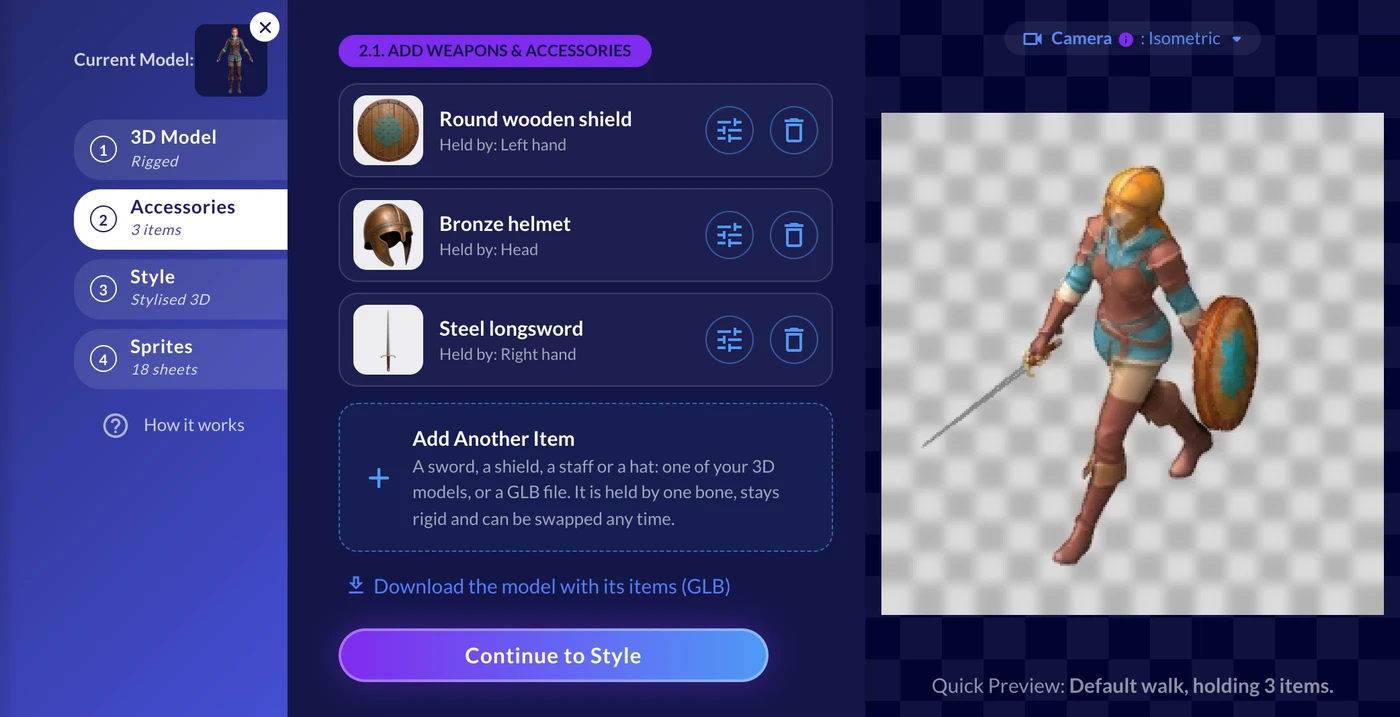
On November 5, 2026, Ludo.ai added Accessories to its Directional Sprites workflow. A game creator can now attach a separately modeled sword, shield, helmet or other item to a rigged 3D character and render matching 2D sprite animations from up to eight directions. This is a product update rather than a new game release. The details come from Ludo's official November changelog.
Why a separate piece of equipment matters
Previously, equipment drawn into the character reference could become baked into the body mesh. That made a blade bend during animations or forced artists to rebuild a character to swap weapons. The new Accessories step, placed between 3D Model and Style, keeps each item as a rigid model attached to one skeleton bone, so it moves with the hand, head or back.
Developers need a rigged character, plus an unrigged accessory model or an imported GLB of up to 30 MB. The tool suggests a position from the accessory's type and shape. Users can change its bone, movement, rotation and scale, preview the animation, then attach the item. Finger closing works only if the character rig includes finger bones.

From the same rig to eight directional sprite sheets
Once attached, the equipment is saved with the character. Creators can download the equipped GLB or generate sprites showing the same sword and shield in walk, run and attack animations. This is especially relevant to top-down and isometric games with character loadouts: the item can be changed without redesigning the core character.

AI-agent fitting via API and MCP
The public API exposes fitDirectionalAccessory, which returns two-angle previews and checks such as body intersection and grip distance. An agent can revise placement and ask for a new preview. attachDirectionalAccessories combines up to eight items into an equipped GLB for sprite generation. API and MCP access are described for Pro and Studio plans.
Ludo says fitting, attaching and quick previews do not consume generation credits. Rendering sprite sheets still costs one promotional credit per sheet, and generating a new 3D item costs separately. This is the vendor's demonstration, not a gameplay test performed by GameSlash. Read the official update and API documentation for implementation and current prices.