Back to Tools
Online systems and backends

Godot: High-level Multiplayer

By Godot contributors

Start Godot host/client RPCs with matching node paths, authority and transport awareness.
guide
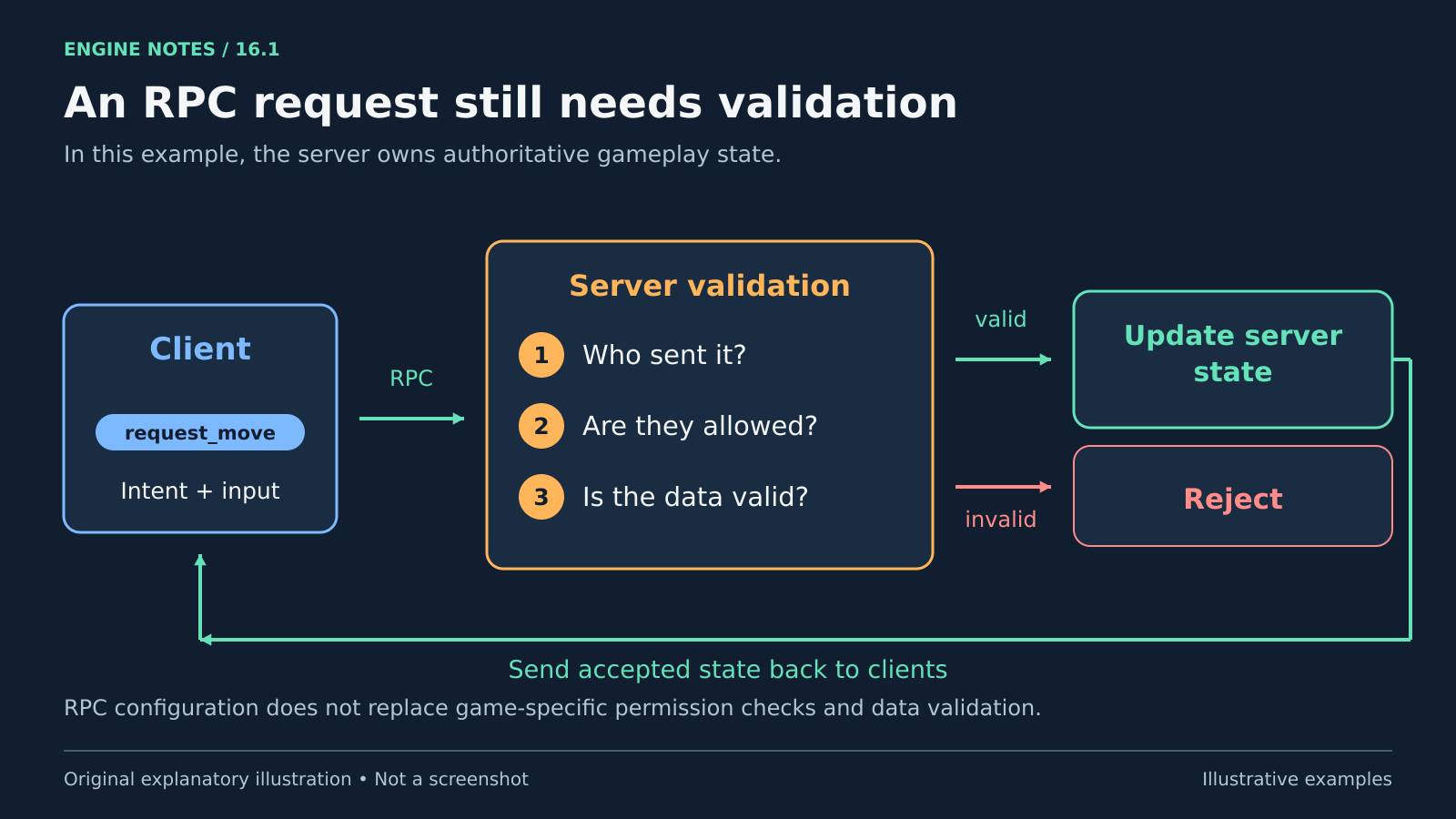
A client sends a movement request to a server. The server checks sender identity, permission and data, updates authoritative state only for valid requests, and rejects invalid input.
A synthetic server-authoritative RPC design. Validation rules and accepted-state updates are game-specific. Original explanatory artwork prepared for GameSlash with AI assistance. Documentation is credited as the factual source only; no source imagery reused. Concept source

Use it for: A co-op prototype with explicitly chosen server-owned state.

Start: 1) Initialize ENetMultiplayerPeer as server/client and assign it to MultiplayerAPI. 2) Test RPCs with matching node paths and declarations. 3) Add connection/disconnection handling from the lobby example.
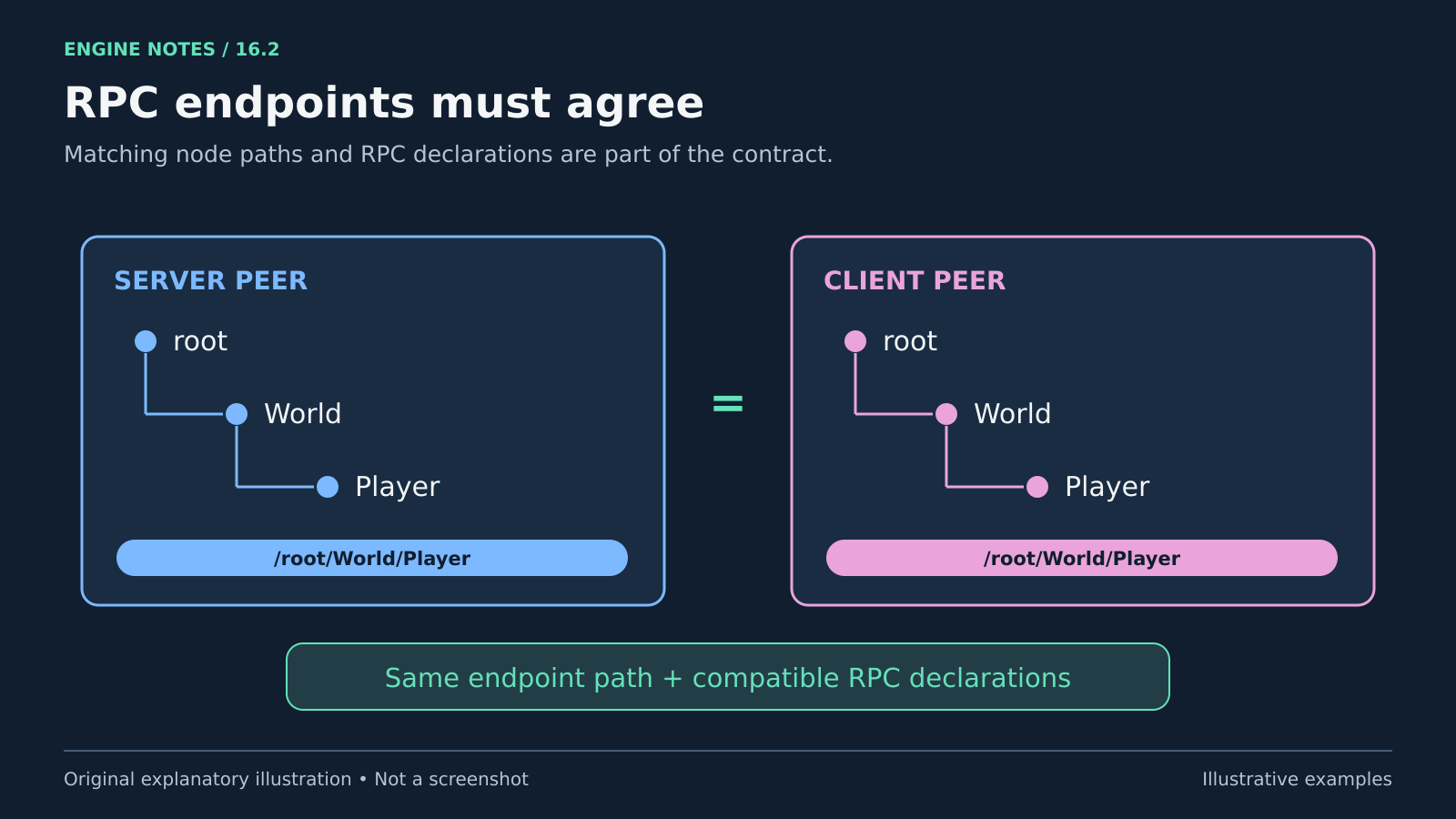
Server and client peers show the same synthetic node hierarchy root, World, Player and the same absolute path /root/World/Player. A callout also requires compatible RPC declarations.
Illustrative matching-node-path requirement. Both peers must also agree on the RPC declarations and signatures described by Godot documentation. Original explanatory artwork prepared for GameSlash with AI assistance. Documentation is credited as the factual source only; no source imagery reused. Concept source

Try checking: Separate host/client instances, failed connections, disconnects and invalid client input.

Limits: Web targets lack native raw TCP/UDP and need supported transports such as WebSocket/WebRTC. RPCs still require game-specific permission and data validation.

Source: Official guide

View source